Critical Peace and Civil Society
FERDA FAHRİOĞLU
See the Course Description in Kurmancî
Overview
This online lab examines the role of civil society, as a central mid-level actor in peace-building processes, including civil society organizations (CSOs), religious and ethnic leaders, intellectuals, and professional associations, and their capacity to bridge decision-makers and conflict-affected communities.
Structured as an interactive seminar, the course integrates academic literature with experiential knowledge. Representatives from member organizations of the Critical Peace Network, including groups working in human rights, women’s rights, LGBTQI+ advocacy, cultural heritage, memory, and education, will participate as guest speakers. The course places particular emphasis on peace-building initiatives related to the Kurdish issue in Turkey and Syria, with contributions from practitioners and students from Rojava University, who will share field experiences from civil society work conducted under challenging conditions.
Students will engage in weekly thematic discussions, practitioner dialogues, and case study analysis. Course requirements include active participation and a very short research paper examining a civil society organization operating in a peace-related field in Syria/Rojava?. Designed to provide a secure environment for all participants, the course aims to foster critical reflection, comparative analysis, and context-sensitive understanding of civil society’s evolving role in sustainable peace-building processes.
Learning Outcomes
- A detailed understanding of the concept “Critical Peace”.
- Concerning interdisciplinary thinking which spans the disciplines of political science, peace and conflict studies, and sociology.
- Examining cases in conflict zones from a perspective of peace and conflict resolution.
- The development of argumentation and deliberation skills for the purpose of engaging in evidence-based debate.
- Listening to and conducting comparative analysis of field experiences from civil society representatives in Turkey and Syria.
Instructors

Ferda Fahrioğlu
Ferda Fahrioğlu is one of the Academics for Peace who reacted to the ongoing conflicts in the Kurdish region of Turkey in 2016 with the declaration “we will not be a party to this crime” calling for non-conflict. For signing the declaration, she was first exiled and then dismissed from her university and public service in February 2017 by decree with the force of law. Fahrioğlu received her PhD in Political Science and International Relations from Yıldız Technical University in 2019. She works on the Kurdish issue, peace studies, gender and mediation. Since 2019, she has been working professionally and voluntarily in rights-based civil society organizations. Since 2021, she has been conducting various studies in the field of Critical Peace Studies at Off University.
Certification
This course is hosted by Humboldt-Universität zu Berlin, Institute for European Ethnology and Zanîngeha Rojava, Department of Political Science and certified with 4 ECTS upon successful completion.
Please check the course requirements from the course syllabus and inform your instructor(s) about your request to receive a certificate for this course.
You will find the full syllabus on Moodle course page.
At the end of the semester, the instructors will inform the learning designer about your request and grade. The certificate will be prepared with the university secretariat and it may take up to 8 weeks.
Registration
Our courses are held on a digital learning platform, Moodle. Before you create your account on Moodle, we have some notes for your and others’ digital security.
- When you register, you can use a nickname. Nicknames with offensive, racist or sexist undertones will not be accepted.
- Communication outside of the platform is not private. It is a solidarity action with people who would like to stay anonymous for different reasons. Please use our secure platform to communicate with others and respect their choices of communication channels.
- We aim to create an inclusive learning environment with our participants and educate ourselves in a more inclusive language. Be eager and tolerant to learn from each other and challenge any discriminating language. You can have a look at it here.
Creating a new account and registering to a course on Moodle
1. The link will take you to the Off University Moodle homepage.
2. Click the “Log in” button on the top right side of the page.
If you have an account on Off University Moodle, please login and continue from step 7 below.
3. Scroll down to see “Create new account” and click the button.
4. Please fill in the fields marked as *required.
You can use false information to protect your identity and increase your safety. You can enter a nickname, a false email address that resembles the format, such as name@example.org etc. Please note down your user name and password in a safe place.
5. Once you created your account, please wait until the next working day to continue.
Your account needs activation which will be done by Off University. We will need some time to activate your account. This can take up to 24 hours on weekdays and longer on weekends.
6. Please login to check whether your account it active. Once you can login, you will find the available courses on the home page of Moodle and will be able to register by clicking the course title.
7. You can now discover the course page. The first item on the page, General, contains the syllabus and the announcements. Please follow these announcements to stay up to date about your course.
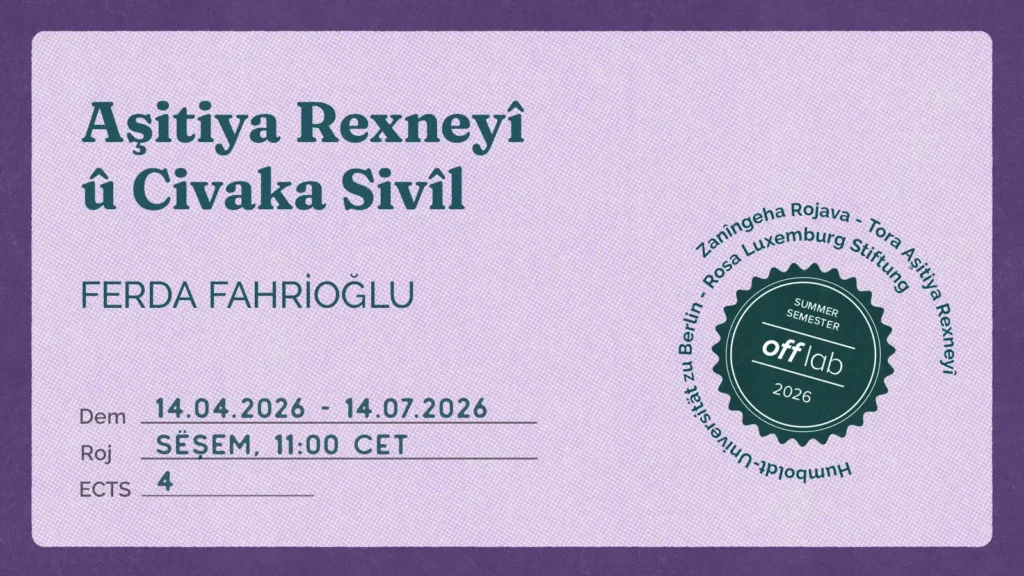
Course Details
Duration
14.04.26 – 14.07.26
Time
Tuesdays, 12:00 CET
Credits
4 ECTS
Language
Kurmancî
Host Institutions
Humboldt-Universität zu Berlin,
Zanîngeha Rojava
Registration:
Supported by: