
Performance Ethnography
Living the Historical Rupture
Olena Kalashnykova, Daria Vystavkina
Overview
We live in a time when wars, revolutions, political repression, and social or ecological crises can rupture the present without warning. Such ruptures disrupt familiar orientations: communities transform or disperse, identities lose their recognition, and the narratives through which we understood our past and future no longer correspond to the realities we inhabit.
This course explores the question: What does it mean to live through historical rupture?
Approaching this question through performance ethnography, the course uses biographical theatre as both a research method and artistic practice. Playback Theatre creates a temporary research community grounded in trust and ethical witnessing, where personal stories are transformed into improvisational performance. Documentary Theatre works with archives, testimonies, artifacts, and embodied memory to compose performances that connect individual experience with historical contexts.
The course culminates in the development and presentation of collaborative documentary performances and a reflection on performance ethnography as a method of knowledge production.
Learning Outcomes
A general understanding of:
- The purpose and structure of the course as a practice-based research laboratory
- Performance ethnography and biographical theatre as methodologies of inquiry
- The relationship between individual biography, collective memory, and historical rupture
- Theatre as a medium of knowledge production and social dialogue
- The principles of Playback Theatre and Documentary Theatre
- The role of embodiment, emotion, and narrative in shaping lived experience
- Ethical frameworks for working with testimony, trauma, and sensitive material
- The significance of community, trust, and ritual in collaborative artistic processes
The skills to be gained upon active participation:
- Applying Playback Theatre techniques to explore and translate lived experience
- Conducting attentive and ethically grounded storytelling interviews
- Transforming personal narratives into embodied performative forms
- Analyzing stories using narrative and structural frameworks
- Developing documentary theatre material from archives, memory fragments, and testimonies
- Structuring and composing a short performance piece individually or collaboratively
- Reflecting critically on the relationship between theory and artistic practice
- Engaging responsibly in collective creative processes
- Articulating insights from practice-based research in written analytical form
Course Outline
You can see and download the course syllabus below.
Instructors
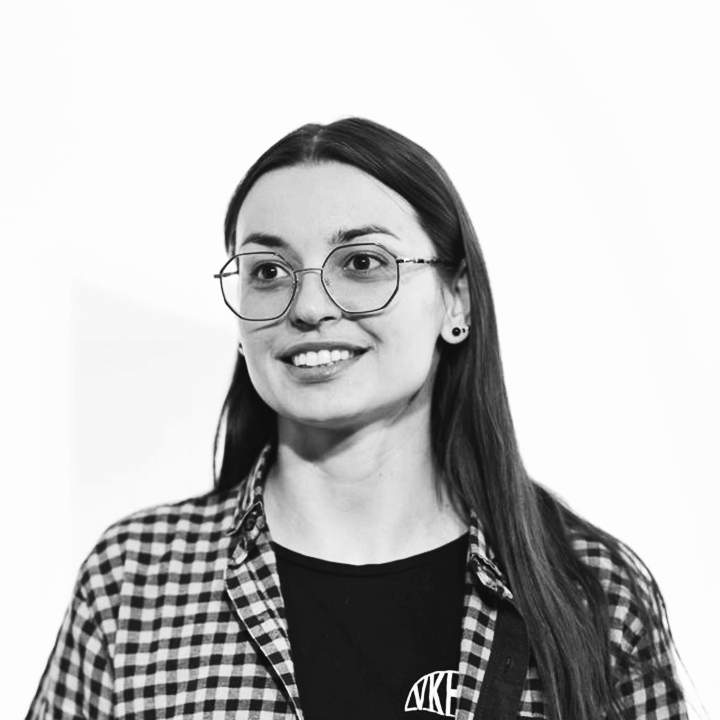
Olena Kalashnykova
Olena Kalashnykova is a Ukrainian-Lithuanian applied theatre practitioner, accredited Playback Theatre trainer, and researcher working at the intersection of performance, community dialogue, and embodied knowledge. She currently serves as Vice President of Neformalaus Ugdymo ir Konsultacijų Centras “Prosperis” (Lithuania), where she curates and leads cultural, social, and educational initiatives using Playback Theatre with displaced communities, refugees, and marginalized groups. Accredited by the Center for Playback Theatre (New York), she has more than fifteen years of professional experience in applied theatre and in psychology and social sciences. She is co-founder of the Ukrainian Playback Theatre School and the Baltic Playback Theatre and Psychodrama School, where she develops curricula, leads conductor and ensemble training modules, and facilitates supervision spaces for practitioners working in socially sensitive contexts.
As co-founder, actress, and conductor of the Playback Theatre group “Vakhtery,” Kalashnykova has led numerous socially engaged performance projects across Ukraine, Lithuania, Poland, and Germany. Her work focuses on trauma-informed facilitation, dialogic formats, and the use of performance as a method for strengthening social cohesion and preserving dignity in times of crisis.
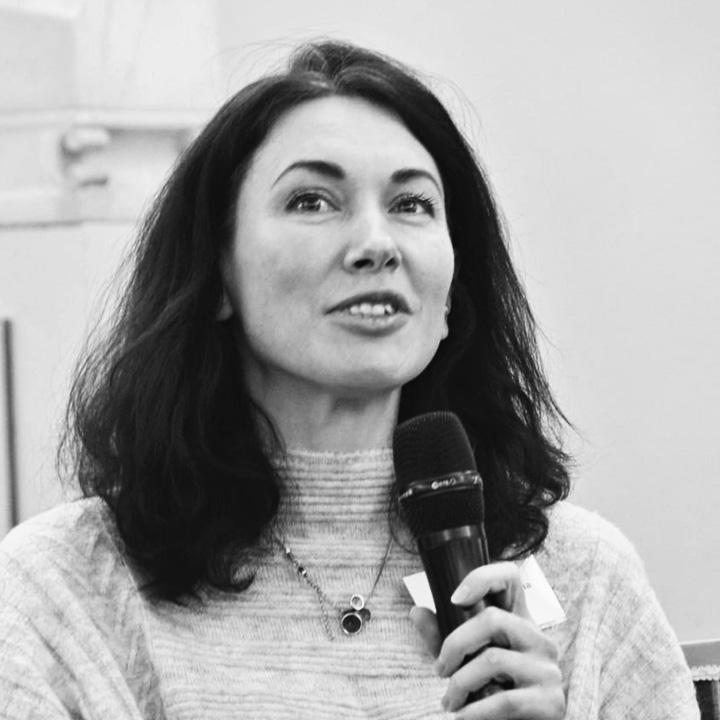
Daria Vystavkina
Daria Vystavkina earned her Ph.D. in Sociology from V. N. Karazin Kharkiv National University. Her research lies at the intersection of the sociology of culture, collective memory, and art-based methodologies, with a particular focus on performance ethnography. Since 2018, she has been actively engaged in social theatre practices, including documentary theatre and playback theatre. She has participated in performances in Odesa (Ukraine) and currently performs in Cologne (Germany). She is a member of the Ukrainian Playback Theater sGraia and the German Playback Theater Lamaeng. Her current research explores how playback and documentary theatre foster dialogue on pressing social issues, and how theatre, understood as an ethnographic method, contributes to the production and interpretation of social knowledge.
Daria has taught at the University of Bonn, where her courses have included Sociology of Crisis and Documentary Theatre and Dialogue. She is currently a Philippe Schwarz Initiative Fellow at the Department of East European History at the University of Bonn.
Certification
This course is hosted by University of Bonn, Department of Eastern European History and certified with 6 ECTS upon successful completion.
Please check the course requirements from the course syllabus and inform your instructor(s) about your request to receive a certificate for this course.
You will find the full syllabus on Moodle course page.
At the end of the semester, the instructors will inform the learning designer about your request and grade. The certificate will be prepared with the university secretariat and it may take up to 8 weeks.
Registration
Our courses are held on a digital learning platform, Moodle. Before you create your account on Moodle, we have some notes for your and others’ digital security.
- When you register, you can use a nickname. Nicknames with offensive, racist or sexist undertones will not be accepted.
- Communication outside of the platform is not private. It is a solidarity action with people who would like to stay anonymous for different reasons. Please use our secure platform to communicate with others and respect their choices of communication channels.
- We aim to create an inclusive learning environment with our participants and educate ourselves in a more inclusive language. Be eager and tolerant to learn from each other and challenge any discriminating language. You can have a look at it here.
Creating a new account and registering to a course on Moodle
1. The link will take you to the Off University Moodle homepage.
2. Click the “Log in” button on the top right side of the page.
If you have an account on Off University Moodle, please login and continue from step 7 below.
3. Scroll down to see “Create new account” and click the button.
4. Please fill in the fields marked as *required.
You can use false information to protect your identity and increase your safety. You can enter a nickname, a false email address that resembles the format, such as name@example.org etc. Please note down your user name and password in a safe place.
5. Once you created your account, please wait until the next working day to continue.
Your account needs activation which will be done by Off University. We will need some time to activate your account. This can take up to 24 hours on weekdays and longer on weekends.
6. Please login to check whether your account it active. Once you can login, you will find the available courses on the home page of Moodle and will be able to register by clicking the course title.
7. You can now discover the course page. The first item on the page, General, contains the syllabus and the announcements. Please follow these announcements to stay up to date about your course.
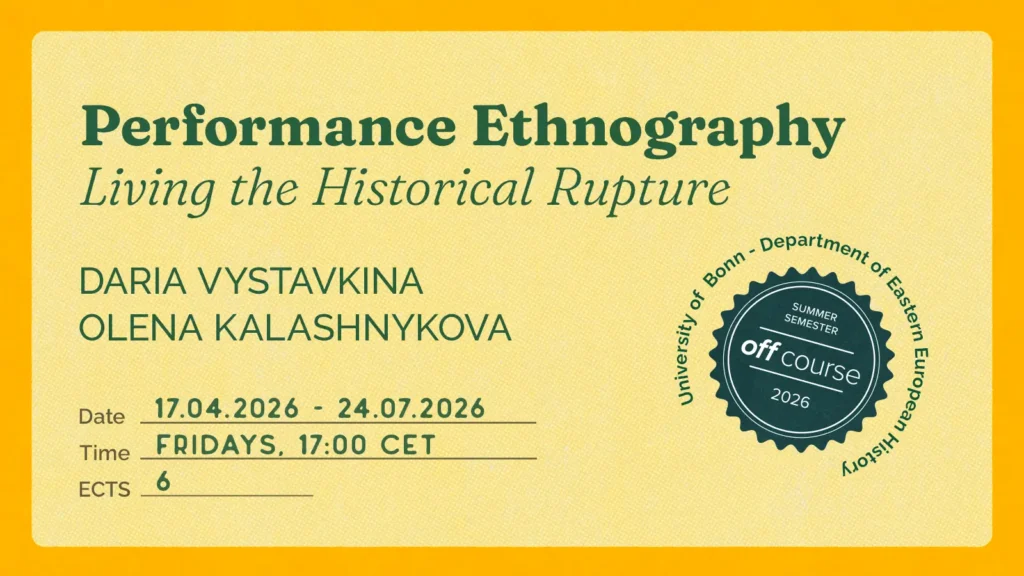
Course Details
Duration
17.04.26 – 24.07.26
Time
Fridays, 17:00 CET
Credits
6 ECTS
Language
English
Host Institution
University of Bonn, Department of Eastern European History
Registration:
Supported by: