
The Everyday and the Unremembered
Gendered Memories of Conflict
RUŞEN IŞIK
Overview
This online laboratory, supported by the Memory Studies Association, examines how armed conflict is remembered through a gendered lens, shifting attention away from dominant narratives centered on combat, heroism, and spectacular violence. Instead, it focuses on what remains in the background: the everyday practices that sustain life under violence, the invisible labor of survival, and the forms of memory that remain unrecognized or excluded from official narratives.
Rather than treating memory as a representation of the past, the course approaches it as a lived and ongoing condition, structured by waiting, uncertainty, and unresolved loss. Drawing on feminist memory studies, the anthropology of the everyday, and the instructor’s doctoral and continuing research on women partners of guerrillas in the Kurdish conflict, the course develops conceptual and analytical tools to examine how memory is produced, silenced, and contested.
The course adopts a thematic and comparative approach, examining how similar memory processes — disappearance, waiting, silence, survival — emerge across different contexts (including Latin America, the post-Yugoslav space, and post-conflict settings), rather than organizing the course by region. Designed as an interactive online laboratory, it prioritizes collaborative inquiry, iterative analysis, and collective knowledge production, explicitly connecting teaching and research by involving participants in materials related to the instructor’s research trajectory.
Learning Outcomes
- Engage critically with key concepts in feminist memory studies (post-memory, counter-memory, structural violence, the everyday)
- Identify how everyday practices of survival and care remain structurally excluded from dominant memory narratives
- Recognize how temporal experiences such as waiting and unresolved loss shape lived memory
- Analyze testimonies, oral histories, and cultural artifacts with ethical sensitivity
- Situate specific cases within broader comparative and theoretical frameworks
- Contribute to a collective analytical project through iterative, research-based collaboration
Course Outline
You can see and download the course syllabus below.
Instructors
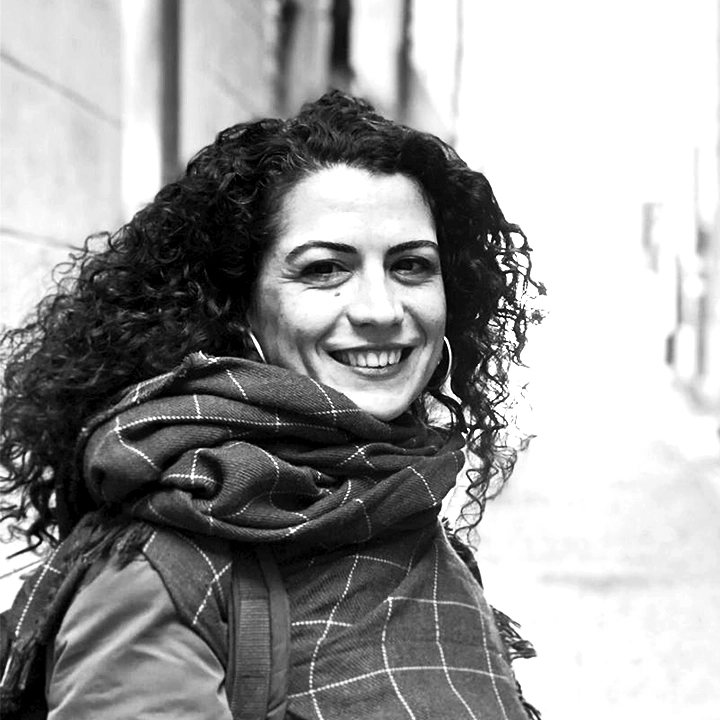
Ruşen Işık
Ruşen Işık is a sociologist, psychotherapist, and independent researcher. She holds a PhD in Sociology from the Université de Bretagne Occidentale, France, and a BSc in Psychology and an MSc in Social Psychology from Middle East Technical University (METU), Ankara. She is a signatory of the Academics for Peace petition (2016). Her doctoral research, supported by the PAUSE program for scholars at risk, examined the experiences of women partnered with guerrillas in the Kurdish conflict. She is affiliated with the Mesopotamia Observatory of Justice (Mojust), a Geneva-based foundation working on access to justice for victims of international crimes and human rights violations in the Middle East. Her research focuses on gender, political violence, memory, displacement, and everyday survival. She also practices psychotherapy.
Certification
This course is hosted by Philipps-Universität Marburg, Center for Conflict Studies and certified with 6 ECTS upon successful completion.
Please check the course requirements from the course syllabus and inform your instructor(s) about your request to receive a certificate for this course.
You will find the full syllabus on Moodle course page.
At the end of the semester, the instructors will inform the learning designer about your request and grade. The certificate will be prepared with the university secretariat and it may take up to 8 weeks.
Registration
Our courses are held on a digital learning platform, Moodle. Before you create your account on Moodle, we have some notes for your and others’ digital security.
- When you register, you can use a nickname. Nicknames with offensive, racist or sexist undertones will not be accepted.
- Communication outside of the platform is not private. It is a solidarity action with people who would like to stay anonymous for different reasons. Please use our secure platform to communicate with others and respect their choices of communication channels.
- We aim to create an inclusive learning environment with our participants and educate ourselves in a more inclusive language. Be eager and tolerant to learn from each other and challenge any discriminating language. You can have a look at it here.
Creating a new account and registering to a course on Moodle
1. The link will take you to the Off University Moodle homepage.
2. Click the “Log in” button on the top right side of the page.
If you have an account on Off University Moodle, please login and continue from step 7 below.
3. Scroll down to see “Create new account” and click the button.
4. Please fill in the fields marked as *required.
You can use false information to protect your identity and increase your safety. You can enter a nickname, a false email address that resembles the format, such as name@example.org etc. Please note down your user name and password in a safe place.
5. Once you created your account, please wait until the next working day to continue.
Your account needs activation which will be done by Off University. We will need some time to activate your account. This can take up to 24 hours on weekdays and longer on weekends.
6. Please login to check whether your account it active. Once you can login, you will find the available courses on the home page of Moodle and will be able to register by clicking the course title.
7. You can now discover the course page. The first item on the page, General, contains the syllabus and the announcements. Please follow these announcements to stay up to date about your course.
Course Details
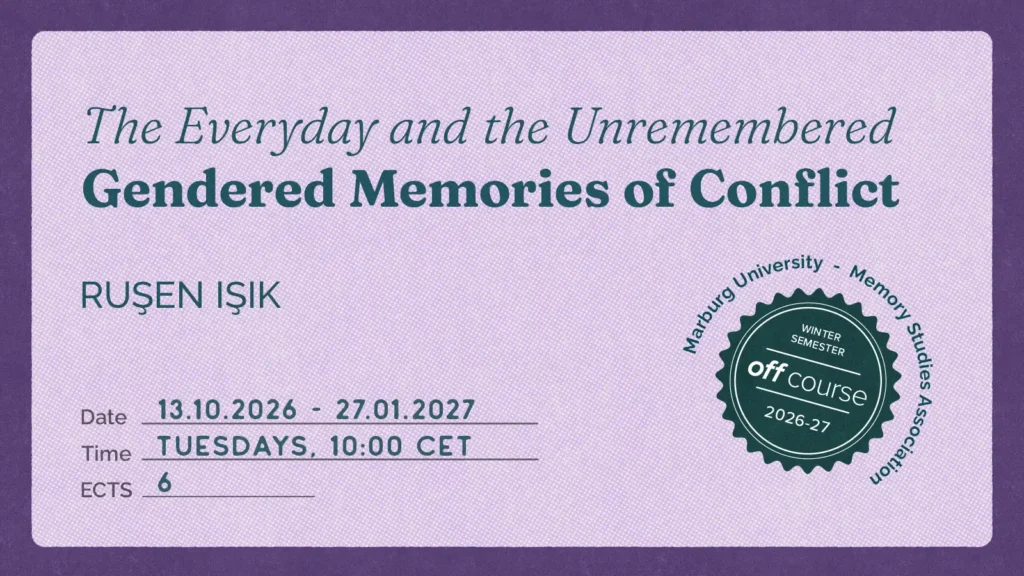
Duration
13.10.26-27.01.27
Time
Tuesdays, 10:00 CET
Credits
6 ECTS
Language
English
Host Institution
Marburg University, Center for Conflict Studies
Registration:
Supported by: