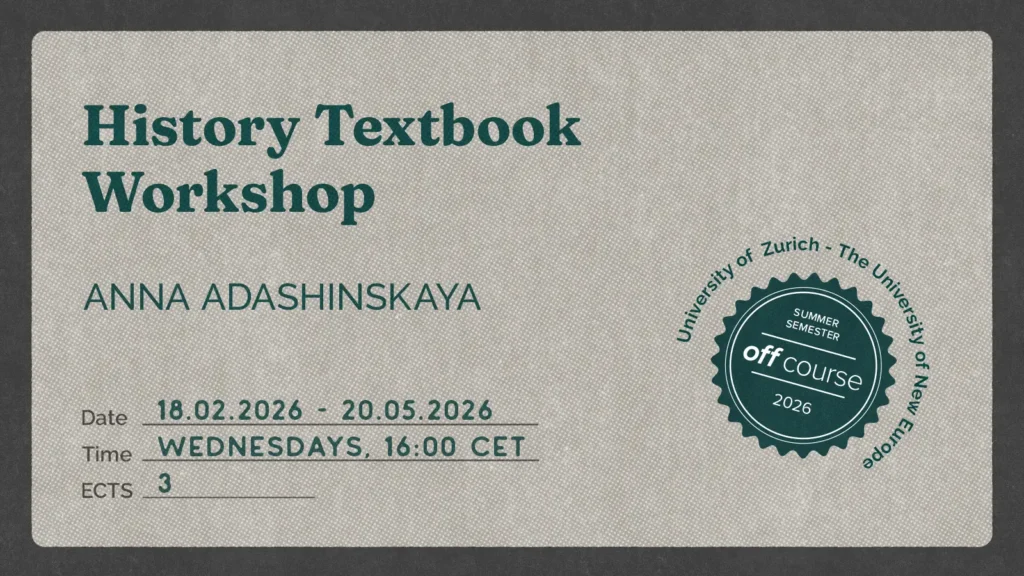
History Textbook Workshop
ANNA ADASHINSKAYA
Overview
Are you passionate about history and interested in exploring how historical knowledge is written, interpreted, and used? The History Textbook Workshop is an innovative online course designed for participants aged 14 to 25, which investigates the ways in which history textbooks reflect political, cultural, and ideological frameworks across different countries and contexts. Through interactive and collaborative sessions, students critically examine the real examples of History Textbooks from different countries and periods of contemporary history and analyze how they shape historical narratives, influence identities, and convey political messages, while developing key skills in source criticism and comparative analysis.
This course challenges the notion of textbooks as neutral sources giving access to the knowledge of the past. By comparing how the same historical events are presented in textbooks from conflicting and competing national traditions, students will discover how omissions, emphases, and interpretative frameworks reveal the political contexts in which these materials were produced. This comparative approach helps students understand not just whose history is taught, but why certain stories are told and others are silenced.
Learning Outcomes
A general understanding of:
- History textbooks as constructed narratives and the political, cultural, and ideological biases that shape them
- Such phenomena as ‘collective memory’, ‘national identities’, ‘memory wars’ and ‘usable past’
- The mechanisms through which nationalist, imperial, and ethnocentric perspectives are embedded in educational narratives
- The implications of the transition from communist to post-communist historical narratives
- The production and authorization of historical knowledge within public sphere institutions
- Teleological historical discourses and alternative approaches to teaching contested histories as shared past.
The skills to be gained upon active participation:
- To apply source criticism techniques to educational materials
- To use comparative methodologies for discourse analysis across different national and ideological contexts
- To identify and deconstruct teleological narratives and anachronistic projections in historical writing
- To analyze how language, terminology, and framing choices shape historical meaning
- To engage actively with diverse perspectives and others’ viewpoints
- To collaborate with peers to produce critical analyses of history textbooks
- To contribute to public discourse about the political uses of the past
- To present and articulate complex arguments about sensitive historical topics in an international, multicultural learning environment
Instructors
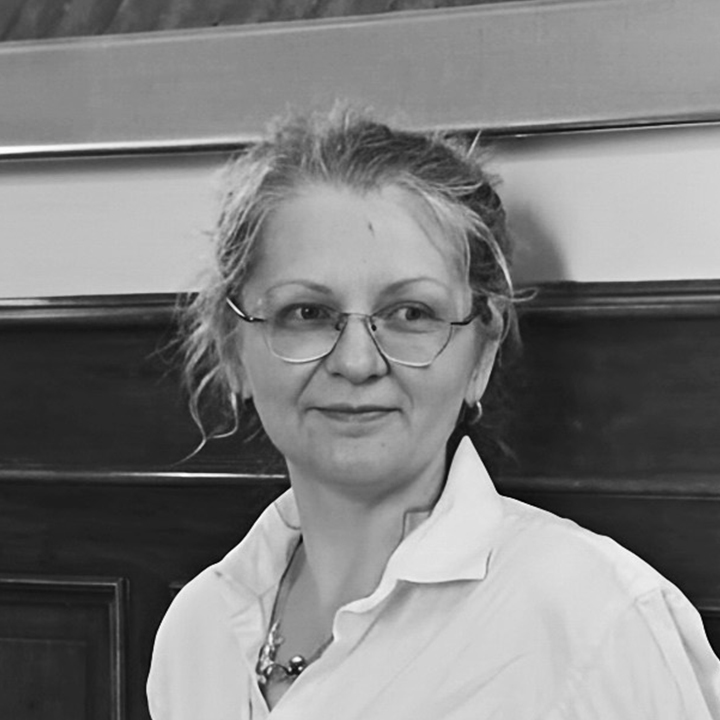
Anna Adashinskaya
Anna Adashinskaya is a historian of Byzantium and Slavic Balkan states. After receiving her PhD in Medieval Studies from Central European University, she has held research and teaching positions at the Higher School of Economics (quitted in 2022), the Centre for Anatolian Civilizations at Koç University, the Leibniz Institute for European History, and the University of Fribourg, where she has engaged with medieval history in close dialogue with its modern interpretations and narratives.
Her postdoctoral research has explored such topics as female patronage in Epirus, votive portraiture in Moldavia, and Byzantine art not only as a historical source but also as a form of historiographic discourse. She has worked on commemorative practices in medieval Southeastern Europe, with attention to how memory, power, and piety are narrated. Currently, she studies commemorative techniques in the early Ottoman Balkans, while critically reflecting on how such themes are framed in scholarly writing and history textbooks
Certification
This course is hosted by University of Zurich, History Department and certified with 3 ECTS upon successful completion.
Please check the course requirements from the course syllabus and inform your instructor(s) about your request to receive a certificate for this course.
You will find the full syllabus on Moodle course page.
At the end of the semester, the instructors will inform the learning designer about your request and grade. The certificate will be prepared with the university secretariat and it may take up to 8 weeks.
Registration
Our courses are held on a digital learning platform, Moodle. Before you create your account on Moodle, we have some notes for your and others’ digital security.
- When you register, you can use a nickname. Nicknames with offensive, racist or sexist undertones will not be accepted.
- Communication outside of the platform is not private. It is a solidarity action with people who would like to stay anonymous for different reasons. Please use our secure platform to communicate with others and respect their choices of communication channels.
- We aim to create an inclusive learning environment with our participants and educate ourselves in a more inclusive language. Be eager and tolerant to learn from each other and challenge any discriminating language. You can have a look at it here.
Creating a new account and registering to a course on Moodle
1. The link will take you to the Off University Moodle homepage.
2. Click the “Log in” button on the top right side of the page.
If you have an account on Off University Moodle, please login and continue from step 7 below.
3. Scroll down to see “Create new account” and click the button.
4. Please fill in the fields marked as *required.
You can use false information to protect your identity and increase your safety. You can enter a nickname, a false email address that resembles the format, such as name@example.org etc. Please note down your user name and password in a safe place.
5. Once you created your account, please wait until the next working day to continue.
Your account needs activation which will be done by Off University. We will need some time to activate your account. This can take up to 24 hours on weekdays and longer on weekends.
6. Please login to check whether your account it active. Once you can login, you will find the available courses on the home page of Moodle and will be able to register by clicking the course title.
7. You can now discover the course page. The first item on the page, General, contains the syllabus and the announcements. Please follow these announcements to stay up to date about your course.
Course Details
Duration
18.02.26 – 20.05.26
Time
Wednesdays
16:00 – 18:00 CET
Credits
3 ECTS
Language
English
Host Institution
University of Zurich, History Department
Registration:
Supported by: